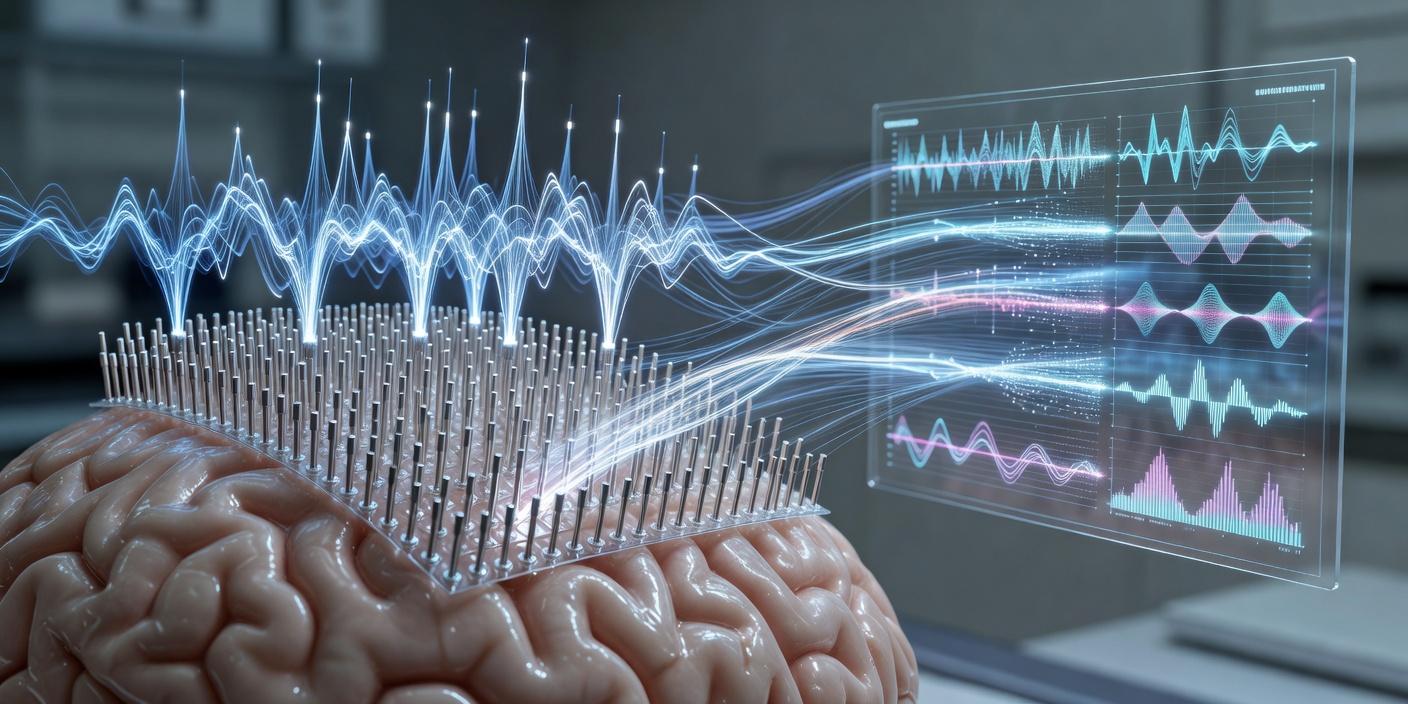
Four ways to get a signal
The design space is mostly a trade between how close you get to neurons and how much damage you do getting there. At one end are penetrating microelectrode arrays. The best known is the Utah array, made by Blackrock Neurotech: a square of silicon a few millimetres on a side carrying around a hundred needle-like electrodes that sit in the cortex and record individual neurons or small groups. This is what the BrainGate consortium — Brown University, Stanford University, Massachusetts General Hospital and the Providence VA Medical Center among others — has used in trial participants since the mid-2000s. Signal quality is excellent; the price is a craniotomy and a percutaneous connector on the skull.
Electrocorticography (ECoG) grids sit on the surface of the brain under the dura. Electrodes are larger and record the summed activity of populations rather than single cells, so the signal is coarser but more stable over time. Edward Chang's laboratory at the University of California San Francisco has built its speech work on this approach. A third route avoids opening the skull at all: Synchron's Stentrode is a stent-like array threaded up the jugular vein into the superior sagittal sinus, recording through the vessel wall, with a channel count far below the penetrating arrays. A fourth is the flexible polymer thread design used by Neuralink, inserted by robot, with its first human implant announced in 2024. Non-invasive EEG through the scalp sits outside all of this: safe, cheap and too low in bandwidth for the tasks discussed here.
The milestones, in order
Leigh Hochberg and colleagues reported in Nature in 2006 that a man with tetraplegia could move a cursor using a Utah array in motor cortex. In 2012 the same group, again in Nature, described participants controlling a robotic arm well enough to drink from a bottle. The shift toward communication came with Frank Willett and colleagues at Stanford, who in 2021 (Nature) decoded attempted handwriting into text at around 90 characters per minute — faster than previous point-and-click typing.
Two papers in Nature in 2023 marked the current frontier. Willett and colleagues, working with a participant with amyotrophic lateral sclerosis and four penetrating arrays in speech motor cortex, decoded attempted speech at 62 words per minute with a word error rate of about 24 per cent on a 125,000-word vocabulary. Sean Metzger, Chang and colleagues at UCSF, working with a participant who had lost speech after a brainstem stroke and using a 253-electrode ECoG grid, reached 78 words per minute with a similar error rate on a smaller vocabulary, and drove a synthesised voice and animated face. A 2024 report in the New England Journal of Medicine from the University of California Davis (Card and colleagues) pushed accuracy above 97 per cent on a large vocabulary after longer training with a single participant.
How the decoding actually works
None of these systems reads words from the brain. They record firing patterns in the part of motor cortex that would drive the lips, tongue, jaw and larynx, feed those patterns through a neural network trained to output phonemes — the basic sound units of a language — and then hand the phoneme stream to a language model that assembles the most likely words. That last step matters more than the headlines suggest. A strong language model can turn a noisy phoneme sequence into fluent English, which is why vocabulary size and error rate have to be reported together: a system that scores well on a fixed 50-word set may collapse on open speech. It also means the output is a best guess constrained by a model of English, not a transcript of intention.
A fair summary of the 2023 work: with several hours of training data and a language model doing much of the lifting, a person unable to speak can produce text at a pace that supports a conversation, with roughly one word in four wrong. Remarkable, and not yet what a person would accept from a phone.
Durability and the daily burden
Penetrating electrodes provoke scarring, and micromotion between a rigid array and soft tissue degrades signals over months and years. BrainGate participants have kept arrays in place for several years, but the number of usable channels tends to fall. Decoders drift too, so most systems need recalibration — sometimes daily — which in practice means a research team on hand. Nearly all published work still uses a wired connection through a pedestal on the skull; a fully implanted wireless system with a battery, heat limits and a data link is an engineering problem in its own right. ECoG and endovascular designs trade signal detail for slower decay, which is the right trade for some users and not others.
Regulation, cost and what happens if a company stops
In the United States, implanted BCIs reach human participants under the Food and Drug Administration's investigational device exemption; in the UK the Medicines and Healthcare products Regulatory Agency oversees clinical investigations. No BCI is a routine, reimbursed clinical treatment for paralysis in either jurisdiction, and the sensible way to check current status is the regulator's own device listings rather than company announcements. Price is unknown because there is no product. A harder question is maintenance: a retinal implant programme in the last decade left users with devices the manufacturer no longer supported after it moved away from that product. Anyone weighing enrolment in a BCI trial is entitled to ask what happens to the implant if the sponsor changes course.
How to read the next announcement
Look for the vocabulary size alongside the speed; whether the error rate is on open text or a fixed set; how many participants; how many sessions of training; whether the connection was wired; and whether the paper is peer-reviewed or a press release. A single-participant result is a proof of principle. The field has produced several, which is why it is exciting, and why the leap to a device is still ahead.