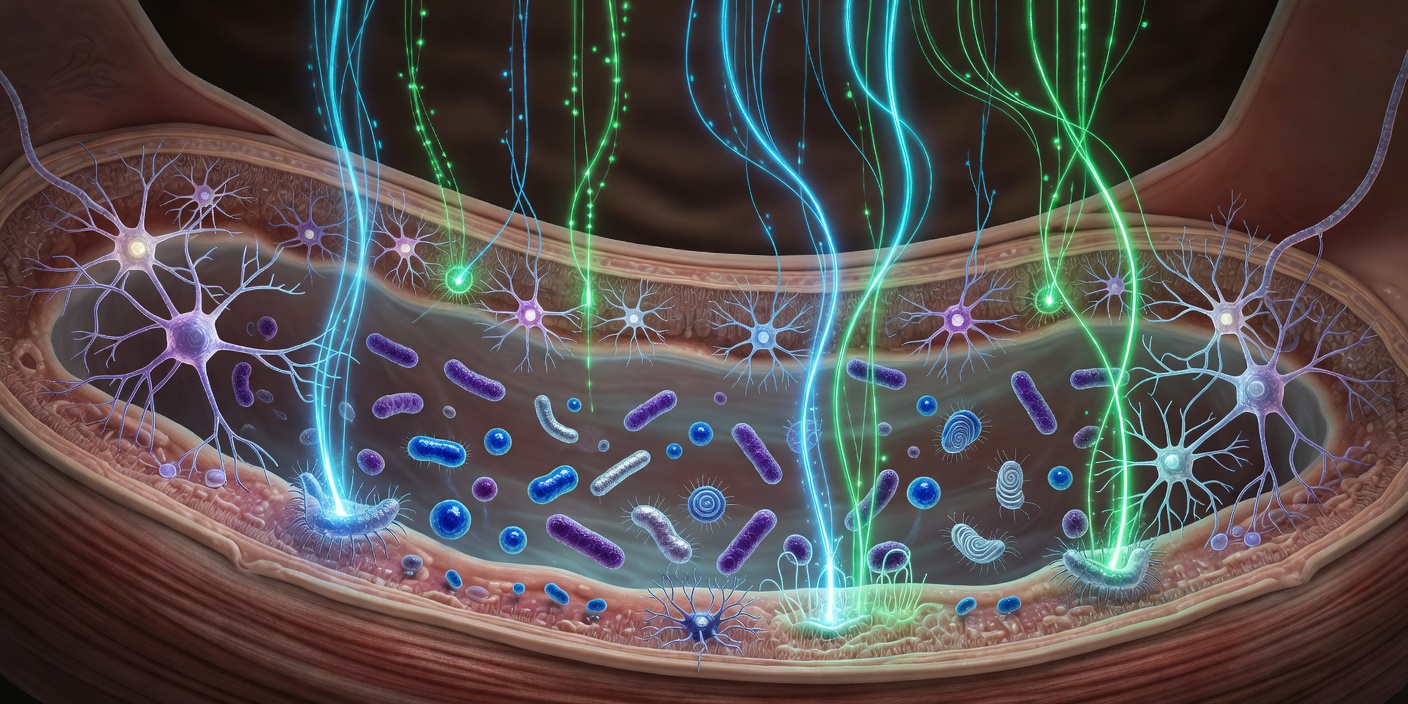
Three routes from gut to brain
Start with anatomy, because it is the part nobody disputes. The gut wall contains the enteric nervous system: hundreds of millions of neurons arranged in two layered networks, the myenteric and submucosal plexuses, capable of coordinating movement and secretion without input from the brain. Running between gut and brainstem is the vagus nerve, most of whose fibres carry information upward rather than down, so the brain hears from the gut far more than it speaks to it. And bathing the whole system is the microbiome — bacteria, archaea, fungi and viruses — whose metabolic products cross into the bloodstream and, in some cases, act on nerve endings directly.
One often-quoted fact needs a caveat attached at once. Around 90 per cent of the body's serotonin is made in the gut by enterochromaffin cells. That serotonin regulates gut movement and signals to local nerves; it does not cross the blood–brain barrier, so it is not the serotonin your mood depends on. "Your gut makes your happiness chemical" is a slogan built on a true number and a false inference.
What mouse work established
The modern field grew from germ-free mice — animals raised with no microbes at all. Sudo and colleagues reported in 2004 that such mice had an exaggerated hormonal stress response that could be normalised by colonising them early in life. In 2011 Javier Bravo, John Cryan, Ted Dinan and colleagues at University College Cork published in the Proceedings of the National Academy of Sciences that feeding mice a particular strain of Lactobacillus rhamnosus reduced anxiety-like and depression-like behaviour and changed GABA receptor expression in the brain, and that cutting the vagus nerve abolished the effect. That vagotomy result is the strongest single piece of evidence that a gut bacterium can influence brain function through a nerve rather than through the blood.
Other groups added mechanism. Braniste and colleagues (Science Translational Medicine, 2014) found the blood–brain barrier more permeable in germ-free mice. Elaine Hsiao, Sarkis Mazmanian and colleagues at Caltech (Cell, 2013) reported that a Bacteroides fragilis strain reduced some autism-related behaviours in a mouse model. Erny and colleagues (Nature Neuroscience, 2015) showed that microglia — the brain's immune cells — mature abnormally in germ-free mice and that short-chain fatty acids, the products of bacterial fibre fermentation, restore them.
The human trial that found nothing
The Cork group did what many do not: they tested their own strain in people. Kelly and colleagues (Brain, Behavior, and Immunity, 2017) gave the same Lactobacillus rhamnosus to healthy men for eight weeks in a placebo-controlled crossover design and measured stress responses, cortisol, inflammation and cognition. They found no effect on any of them. The authors were candid that a striking mouse result had not translated. Whether that is because healthy volunteers have little room to improve, because eight weeks is too short, or because mouse and human gut ecosystems are too different, is unknown; all three are plausible.
This is the clearest example in current neuroscience of why a mouse finding is a starting point and not a conclusion. Germ-free mice are abnormal in dozens of ways beyond their microbes, mouse gut flora differs from human, and rodent behavioural tests for "anxiety" measure how long an animal avoids open space.
Correlation in people
Large human studies do find associations. Valles-Colomer and colleagues (Nature Microbiology, 2019), analysing the Flemish Gut Flora Project and a Dutch cohort, linked the abundance of certain bacterial genera to self-reported quality of life and to a diagnosis of depression. Kelly and colleagues (Journal of Psychiatric Research, 2016) transplanted faecal microbiota from people with depression into rats and saw depression-like behaviour. Neither settles direction. People with depression eat differently, move less, sleep differently and take medication, and each of those reshapes the microbiome. The rat transfer suggests the microbes can carry something, but from a small number of donors.
Parkinson's disease and the Braak hypothesis
The most substantial gut–brain story may be Parkinson's. In 2003 Heiko Braak and colleagues proposed, from the pattern of misfolded alpha-synuclein in post-mortem brains, that the disease might begin in the gut or nose and spread to the brain along nerves. Constipation preceding motor symptoms by years is a long-standing clinical observation. Alpha-synuclein aggregates have been found in gut biopsies. Kim and colleagues (Neuron, 2019) injected synthetic alpha-synuclein fibrils into the gut wall of mice and watched pathology climb the vagus into the brain, with vagotomy blocking the spread. Registry work from Denmark (Svensson and colleagues, Annals of Neurology, 2015) associated truncal vagotomy with lower later Parkinson's risk, though other cohorts have been mixed. Together this is a coherent mechanism with human and animal support — and still a hypothesis, since many people with Parkinson's show no gut-first pattern.
Products, claims and where to check
Probiotic foods and supplements in the UK are regulated as foods, not medicines, and any health claim on a label has to appear on the register of authorised nutrition and health claims that applied in Great Britain after EU exit, with the Food Standards Agency and Department of Health and Social Care responsible. Before believing a mood or "gut–brain" claim on a packet, that register is the place to look. On present evidence, the general advice that applies is dietary rather than microbial: a diet high in fibre feeds the bacteria that make short-chain fatty acids, and that advice stands on many other grounds. Persistent gut symptoms or changes in mood are matters for a GP, not for a strain.